Common Types
* Primary Milia – Occur spontaneously, commonly in newborns and adults.
* Secondary Milia – Develop after skin injury, burns, blistering disorders, laser procedures, or prolonged use of certain topical medications.
* Multiple Eruptive Milia – Numerous milia appearing over a short period.
* Milia en Plaque – A rare form where multiple milia occur on an inflamed plaque of skin.
Common Causes
Milia may develop due to:
* Trapped keratin beneath the skin
* Natural skin cell buildup
* Skin injury or burns
* Blistering skin conditions
* Laser resurfacing or chemical peels
* Long-term use of topical corticosteroids (occasionally)
* Sun-damaged skin
Symptoms
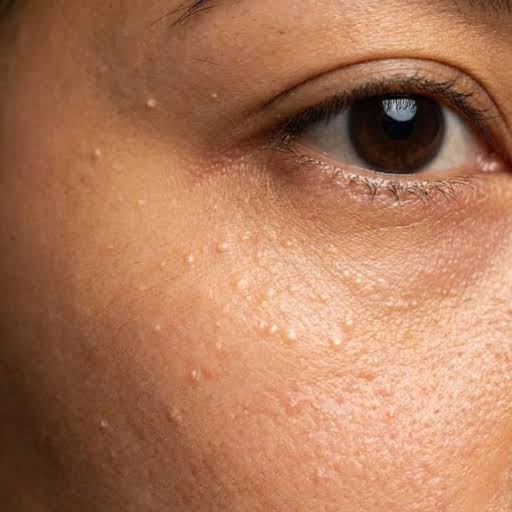
* Tiny white or yellowish bumps (1–2 mm)
* Smooth, firm, dome-shaped lesions
* Usually painless
* No itching or redness in most cases
* Cosmetic concern rather than a medical problem
Commonly Affected Areas
* Around the eyes
* Eyelids
* Cheeks
* Nose
* Forehead
* Chin
Less commonly, milia may appear on the chest, hands, or genital area.
Who is at Risk?
* Newborn babies
* Children and adults
* People with sun-damaged skin
* Individuals recovering from skin injuries or cosmetic procedures
* People with certain blistering skin disorders
Diagnosis
Diagnosis is usually made through a clinical examination by a dermatologist. Additional tests are rarely required unless the diagnosis is uncertain or an underlying skin disorder is suspected.
Prevention
* Protect the skin from excessive sun exposure.
* Avoid unnecessary trauma to the skin.
* Follow a gentle skincare routine.
* Use non-comedogenic skincare products when appropriate.
* Seek proper care after cosmetic procedures.
When to See a Dermatologist
Consult a dermatologist if the bumps increase in number, become inflamed, recur frequently, or cause cosmetic concerns. Medical evaluation is also recommended if the diagnosis is uncertain or if similar lesions appear after skin injury or treatment.